Showing posts with label transport. Show all posts

Saturday, November 22, 2014

La Compagnie Boutique - All Business Class Airline

New Boutique Airline La Compagnie Attractive Paris Fares for Fall 2014

The newly launched, exclusively business-class boutique airline La Compagnie announces attractive fares for its first fall season, with regularly scheduled service between Paris and New York.

Starting today, La Compagnie will fly five times a week between Paris and New York, providing passengers easy access between two of the most popular cities at convenient times.
La Compagnie is offering travelers two special fall fares this season for those traveling between Paris Charles De Gaulle Airport and Newark International Airport, where passengers can enjoy a reduced fare, whether traveling solo or together. As with subsequent promotions, this special offer requires instant ticketing and is nonrefundable. All taxes are included.
• Solo Special: $1,499.00 USD round trip for one, for flights booked today through December 1, 2014 and for travel through December 15, 2014. (Subject to availability. Class of service restrictions apply).

• Trip for Two: $2,499.00 USD round trip for two, for flights booked through October 7, 2014 and for travel through October 31, 2014. (Effective September 8, 2014).
Whether headed westbound or eastbound, one-way or round trip, travelers on La Compagnie will receive the utmost service. The attentiveness begins at the airport, with passengers flying out of Paris offered access to the iCare Premium Lounge in Terminal One at Charles De Gaulle, and those boarding at Newark International offered access to the Art & Lounge in Terminal B, conveniently located a few feet from TSA and check-in.
Delight in “La Carte” dining service created by Michelin-starred chef Christophe Langrée. Menu items such as sliced chicken, quail egg and vegetables in truffle oil and pea soup and fresh mint with almonds are served with style, as are fine cheeses, premium liquors, and French wines including Piper-Heidsieck Cuvée Brut, Château La Bienfaisance from Saint-Emilion, and Le Bourgogne Blanc – La Part des Anges.

Eastbound flights on La Compagnie depart from Newark at 9:45PM and arrive in Paris the next morning at 11:15AM, while westbound flights depart Paris at 5:50PM and arrive in Newark at 8:30PM. 
French in spirit and global in appeal, the airline’s baby blue Boeing 757-200 is designed for comfort with 74 “lie-flat” seats laid out in a 2×2 configuration. Inflight amenities include Samsung Galaxy Tablets preloaded with movies, newspapers, games, books and Caudalie cosmetic amenity kits at every seat.
Travel agents can make bookings through the La Compagnie website. Reservations will soon be available through Sabre, Travel Port and Amadeus Systems as well. For reservations on La Compagnie and to take advantage of the fashionable fall savings, please contact La Compagnie`s call center at 800-218-8187 or visit www.LaCompagnie.com.

Thursday, November 20, 2014

World premiere: Advanced prototype of the flying roadster AeroMobil 3.0

A beautifully designed fully functional prototype of a flying car: the Aeromobil 3.0 was recently revealed in Vienna at the Pioneers festival that celebrates entrepreneurship, technology and innovation.
History of the project

AeroMobil 3.0 prototype was designed and manufactured by engineers led by chief designer and CTO Stefan Klein and CEO Juraj Vaculik, co-founders of the company, in just 10 months after the release of the previous and much more basic pre-prototype of the flying car, the AeroMobil 2.5.

AeroMobil, the flying car, is the core product of the Slovakia based company AeroMobil. It has been in development since 1989, when Stefan Klein, the founder and head of the Department of Transport Design at the Academy of Fine Arts in Slovakia began working on a concept of a flying car.

In 2010, Klein joined forces with Juraj Vaculik and established the company with the objective of commercializing the project. AeroMobil reached a key milestone in 2013, when they successfully demonstrated the functionality of the pre-prototype AeroMobil 2.5.
The AeroMobil 3.0

The current flying car prototype AeroMobil 3.0 incorporates significant improvements and upgrades to the AeroMobil 2.5.

The AeroMobil 3.0 prototype is very close to the final product. Built from the same materials as the final product, such as advanced composite materials for the body shell, wings, and wheels, it also boasts all the main features that will be incorporated into the final product, such as avionics equipment, autopilot and an advanced parachute deployment system.

AeroMobil was designed in a way to fit into existing road infrastructure – its size is comparable to a limousine or a large luxury sedan. It has low maintenance costs and can be parked in regular parking slots in cities. It uses standard gasoline instead of kerosene, and it can therefore be fueled at a regular gas stations.

AeroMobil also implements a number of other advanced technologies, such as a variable angle of attack of the wings, which significantly boosts the efficiency of take-off and shortens the take-off requirements, and sturdy suspension, which enables take-off and landing at relatively rough terrain.

The flying roadster 3.0 prototype has a top groundspeed of 124mph and a flight travel range of 430 miles or up to four hours – enough to reach Aberdeen from London.  In the air, it can fly for four hours, or up to 430 miles, and when its in flight-gliding mode, it uses less fuel than most cars, the company claims.

To fly the car, you do need a pilot’s license, but Aeromobil claims that it is very stable and easy to control.

Pricing for the Aeromobil hasn’t been announced yet but the company said that it will be in the range of supercar pricing. So we’re expecting around 200 000 Euros.


Photography ©AeroMobil


Tuesday, September 30, 2014

Qantas Debuts the Longest Nonstop Flight in the World.

Qantas customers traveling on the popular Sydney-Dallas/Fort Worth route will soon be able to enjoy the world’s largest passenger aircraft on the world’s longest route, with an A380 replacing a B747 from September 2014.
Qantas Group CEO Alan Joyce said the new A380 service was the result of several scheduling changes designed to unlock more flying time, as flagged in February this year under the Qantas Transformation Program.

“As part of our strategy to build a stronger Qantas, we’re reducing the amount of time our domestic and international fleet spend on the ground,” said Mr Joyce.

“Aircraft are one of our biggest fixed costs and maximizing the amount of time they spend in the air is good news for our customers and for Qantas – especially when it comes to the A380.

“We have retimed A380 services between Melbourne and London to create a win-win for both our European and American networks.

“This schedule change unlocks more A380 flying time that we can use on the Dallas route, and now offers four times the number of onward connections to Europe because of the new arrival time of the Melbourne flight into Dubai,” added Mr Joyce.

Mr Joyce said constantly improving onward connections was key to delivering a better flying experience for customers.
“Dallas has become an important gateway for Qantas customers since we started flying there in 2011. It is the hub for our partner American Airlines and offers more than 30 destinations beyond the west coast of the United States as well as parts of Canada and Mexico on their network.

“When you combine the A380 with the onward connections available from Dallas, this is a great example of the right aircraft on the right route,” he added.

The additional range of the A380 over the B747 it replaces on the Dallas route will see the return service operate direct to Sydney rather than via Brisbane. The larger aircraft also means Qantas will fly six return services per week between Sydney and Dallas (every day except Tuesdays) compared to seven days a week with the B747. This represents a net increase of seats on the route by more than 10 per cent per week.
Adjustments will be made to the mix of A380s and B747s flying on the Sydney to Hong Kong route in order to facilitate the upgrade to Dallas services.

Fleet and network adjustments are earmarked to save up to $600 million over three years for the Qantas Group from the overall $2 billion cost reduction target that is at the centre of the airline’s turnaround plans. Increased aircraft utilization and accelerated retirement of older, un-reconfigured B747s form part of this.

Last month Qantas announced a seasonal Perth-Auckland service that uses an A330 aircraft that previously spent weekends on the ground in Perth, when regular business travel demand is much lower. In December last year Qantas increased its Brisbane-Los Angeles schedule to daily.

This month marks the 60th anniversary of Qantas services to the US. In 1954, Qantas operated a Super Constellation from Sydney to San Francisco – its first trans-Pacific route to North America.

Qantas has worked closely with its tourism partners, Destination NSW and Sydney International Airport to secure its new A380 Dallas/Fort Worth service, and previously Tourism and Events Queensland and Brisbane Airport Corporation to secure its daily Los Angeles service.


Qantas customers traveling on the popular Sydney-Dallas/Fort Worth route will soon be able to enjoy the world’s largest passenger aircraft on the world’s longest route, with an A380 replacing a B747 from September 2014.

Qantas Group CEO Alan Joyce said the new A380 service was the result of several scheduling changes designed to unlock more flying time, as flagged in February this year under the Qantas Transformation Program.

“As part of our strategy to build a stronger Qantas, we’re reducing the amount of time our domestic and international fleet spend on the ground,” said Mr Joyce.

“Aircraft are one of our biggest fixed costs and maximizing the amount of time they spend in the air is good news for our customers and for Qantas – especially when it comes to the A380.

“We have retimed A380 services between Melbourne and London to create a win-win for both our European and American networks.

“This schedule change unlocks more A380 flying time that we can use on the Dallas route, and now offers four times the number of onward connections to Europe because of the new arrival time of the Melbourne flight into Dubai,” added Mr Joyce.

Mr Joyce said constantly improving onward connections was key to delivering a better flying experience for customers.

“Dallas has become an important gateway for Qantas customers since we started flying there in 2011. It is the hub for our partner American Airlines and offers more than 30 destinations beyond the west coast of the United States as well as parts of Canada and Mexico on their network.

“When you combine the A380 with the onward connections available from Dallas, this is a great example of the right aircraft on the right route,” he added.

The additional range of the A380 over the B747 it replaces on the Dallas route will see the return service operate direct to Sydney rather than via Brisbane. The larger aircraft also means Qantas will fly six return services per week between Sydney and Dallas (every day except Tuesdays) compared to seven days a week with the B747. This represents a net increase of seats on the route by more than 10 per cent per week.

Adjustments will be made to the mix of A380s and B747s flying on the Sydney to Hong Kong route in order to facilitate the upgrade to Dallas services.

Fleet and network adjustments are earmarked to save up to $600 million over three years for the Qantas Group from the overall $2 billion cost reduction target that is at the centre of the airline’s turnaround plans. Increased aircraft utilization and accelerated retirement of older, un-reconfigured B747s form part of this.

Last month Qantas announced a seasonal Perth-Auckland service that uses an A330 aircraft that previously spent weekends on the ground in Perth, when regular business travel demand is much lower. In December last year Qantas increased its Brisbane-Los Angeles schedule to daily.

This month marks the 60th anniversary of Qantas services to the US. In 1954, Qantas operated a Super Constellation from Sydney to San Francisco – its first trans-Pacific route to North America.

Qantas has worked closely with its tourism partners, Destination NSW and Sydney International Airport to secure its new A380 Dallas/Fort Worth service, and previously Tourism and Events Queensland and Brisbane Airport Corporation to secure its daily Los Angeles service.

ADDITIONAL INFORMATION

- The first A380 flight on the QF7/8 Sydney-Dallas route will operate on 29 September 2014. This will be the first time Qantas has offered First Class on this route.

- The new schedule for the QF9 Melbourne-Dubai-London is effective from 20 July 2014. The flight will depart Melbourne each day at 22:55, arrive into Dubai at 07:05 and land in London at 13:40. On the return journey on 21 July, QF10 will depart London at 13:30, arrive into Dubai at 23;25 and land in Melbourne at 20:55. Customers with existing bookings will be contacted by Qantas or their Travel Agent and advised of their new flight times.


- Customers traveling from Melbourne to Europe will have access to 17 round-trip connections within four hours of landing, compared with 4 under the current timings.

See clip

Wednesday, September 24, 2014

2016 Mercedes-AMG GT


The internet since few days, is deluged with news on the two new iPhones and the iWatch unveiled by Apple, but another beauty shared the same date to be officially unveiled. I am talking about the 2016 Mercedes AMG GT, the replacement for the gullwing SLS AMG, and it has finally arrived. After months of teasing and spying, the wraps are finally off and the first impressions of the flagship sportscar of Mercedes is that it is all that we had expected it to be – stunning! 

The first thing you’ll notice other than the obvious similarity with its predecessor is its name – there is no Benz in the name and the automaker chose to give it a proper Mercedes-AMG designation. Tobias Moers, CEO of Mercedes-AMG GmbH had previously said: “The new Mercedes-AMG GT proves that we will be positioning AMG as a dynamic sports car brand even more strongly and aggressively than before.” This is the second car to be entirely developed by AMG and will roll out exclusively from AMG’s Affalterbach facility in Germany, but we don’t know whether this new nomenclature will set a new precedent for future cars from the Mercedes-AMG stable.
The Mercedes AMG GT will arrive in two trims, the GT and the GT S, both powered by the new 4.0-liter, twin-turbocharged V8 with dry-sump lubrication, dubbed the M178. Both trims have their engines mated to seven-speed dual clutch transmissions that deliver power to the rear wheels. The standard GT boasts a healthy 456 horsepower and 443 pound-feet of torque. The performance figures released by the company claims that it can sprint to 60 miles per hour in 3.9 seconds and carry on to an electronically limited top speed of 189 mph. On the other hand, the GT S makes 503 hp and 479 pound-feet to reach 60 in an estimated 3.7 seconds all the way to a limit of 310 kmh (193 mph).
On the inside, the cabin carries an aviation-theme. The drivers can play with the powertrain’s various modes and settings via the AMG Drive Unit controls on the center console. Mercedes calls it the Drive Unit and it’s supposed to be reminiscent of the V8’s cylinder layout but the design is quite busy and not very good to look at. The pricing is yet to be announced but what we know till now is that the 2016 AMG GT S will be launched in the US in the spring of 2015, and the standard GT will arrive a year later.
With the overall engine size reduced from the previous SLS AMG, the car is better balanced- a 47:53 weight distribution from front to rear. The trick drivetrain is wrapped up in an aluminum space frame chassis with a double-wishbone suspension at all four wheels, boasting of aluminum-forged parts. As for the styling, the gullwing doors have been replaced by normal ones but the overall design is still very crisp and draws its inspiration from the original 300SL. Up front, the big Mercedes star nestled in an oval grille with two massive air intakes at the lower corners are the most prominent elements. The back looks wide thanks to the long, slim taillights poking out to the hefty rear fenders. There’s an electronically controlled rear spoiler which remains well hidden till it’s not deployed.

Sunday, September 21, 2014

Private Jet Falcon 7X

The long range Falcon 7X will soon become the first business jet certified to operate at Daocheng Yading, the world’s highest commercial airport.


The certification campaign at Daocheng, situated in China’s Sichuan province at an altitude of 14,470 ft (4,411 m), was initiated at the request of Chinese customers and is intended to meet demand in Western China for business jets capable of operating at the many small high altitude airports in the region.

The campaign, which began on August 25 and concluded on September 7, enjoyed strong support from the European and Chinese civil aviation authorities EASA and CAAC. Daocheng flight tests started after a series of preliminary flights at Jiuzhai Huang Long Airport near Chengdu (altitude 11,311 ft/3,448 m) with a CAAC pilot at the controls. After an initial landing at Daocheng - the highest ever by a business jet - the 7X performed engines/APU run up followed by a series of takeoffs and landings including some with simulated engine failure. Once finalized the approval will permit the Falcon 7X to operate at altitudes up to 15,000 ft.

“The aircraft handled flawlessly in all conditions of flight and the engines, APUs and pressurizationsystems performed perfectly,” said Philippe Dumas, Dassault Aviation test pilot “This performancehighlights the unparalleled ability of the 7X to operate from difficult short airstrips in the most challengingconditions.”

In addition to setting a new world altitude record for a business jet, the test campaign established a number of other benchmarks for aviation in China. It was the first flight test campaign undertaken over Chinese territory by a foreign registered aircraft, and it will be the first approval to be issued jointly by EASA and CAAC.

The Daocheng certification campaign follows recent 7X demonstration flights at challenging airports such as Saint-Tropez, France, Gstaat in Switzerland and a Mach 0.88 cruise speed record between Teterboro, New Jersey and London City Airport set in May.

“These performance benchmarks highlight the incomparable operating flexibility of the Falcon 7X,” said Chairman and CEO Eric Trappier. “Together with its great range, speed and operating economy, this helps explain the immense popularity of the 7X in the burgeoning Chinese market.”


In recent years, China has emerged as one of the biggest markets for business aviation aircraft and the Falcon line, led by the 7X, has seized a commanding share in this market. Nearly 30 Falcon 7X s are currently flying in the country, making China the second largest market for the long range trijet, after the United States. And with the recently introduced Falcon 5X very large body twin and ultra long range Falcon 8X, the Falcon brand is expected to lead the Chinese market for many years to come.


Monday, May 26, 2014

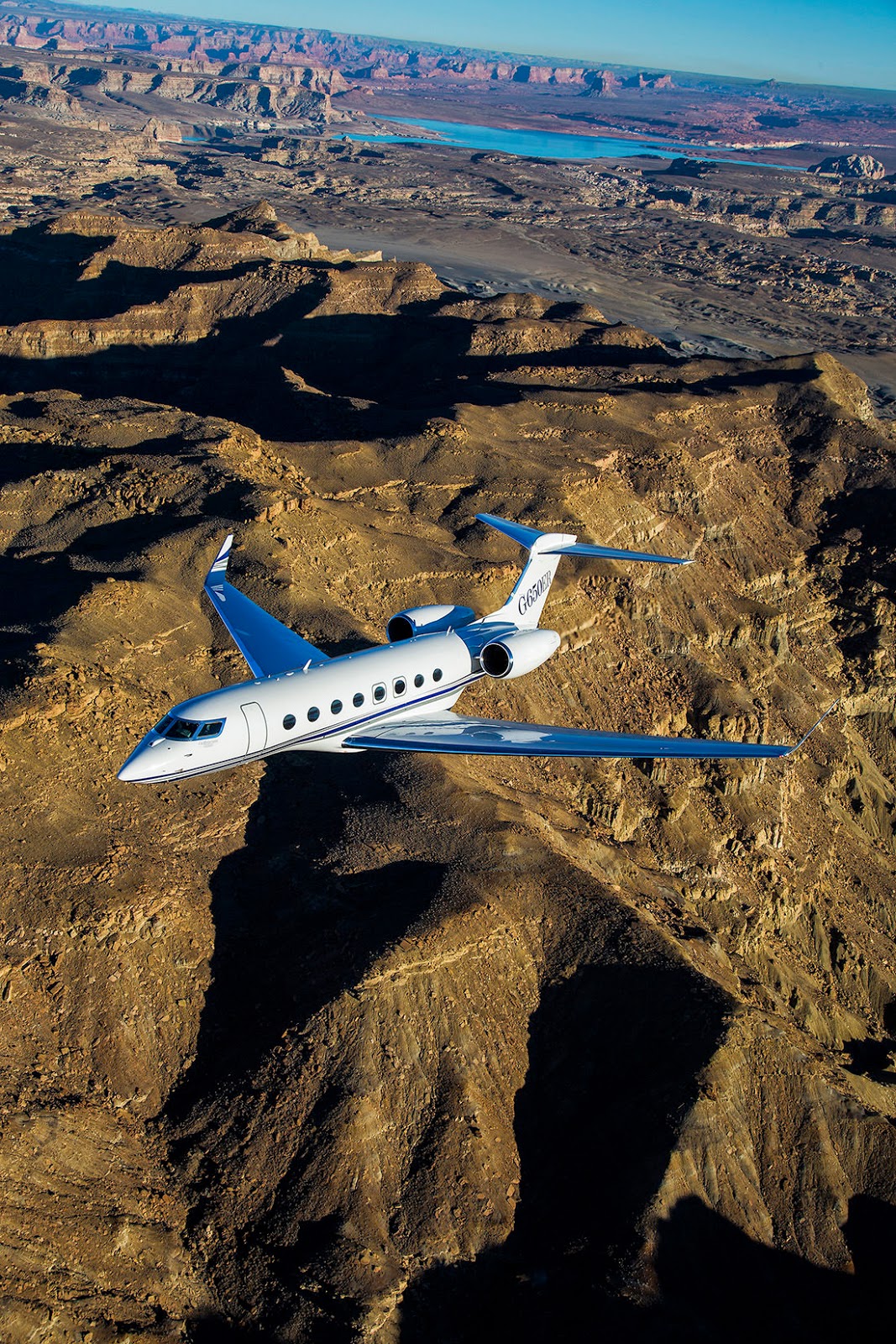
The New Gulfstream G650ER


Gulfstream Aerospace Corp. introduced the new G650ER, an ultra-long-range aircraft that can travel 7,500 nautical miles/13,890 kilometers at Mach 0.85 and 6,400 nm/11,853 km at Mach 0.90, an increase of up to 500 nm/926 km over the range of the G650, which entered service in 2012.
Enhanced Flexibility and Performance

Scott Neal, senior vice president, Worldwide Sales and Marketing, Gulfstream said: “The G650ER provides our customers with greater mission flexibility and the longest range of any business jet”. “It’s the only business aircraft in the world capable of traveling 7,500 nm. This opens up significant nonstop city pairs, including New York to Hong Kong, Dallas to Dubai and San Francisco to Delhi. G650ER owners in Dubai will be able to reach most of the contiguous United States. From Hong Kong, operators can connect with the Eastern Seaboard of the United States. Thanks to the G650ER, the world just got a little smaller.”

Earlier this year, the Gulfstream G650ER set two new speed records during flight testing. The aircraft flew 6,947 nm/12,866 km from Los Angeles International Airport to Tullamarine Airport in Melbourne, Australia, at an average speed of Mach 0.86. The flight, into head winds as high as 13 knots, took 14 hours and 58 minutes. After positioning to Hong Kong, the G650ER flew 7,494 nm/13,879 km to Teterboro, N.J., accomplishing the 14-hour and 7-minute journey at an average speed of Mach 0.865.

“The capabilities of the G650ER are due in part to its twin Rolls-Royce BR725 engines, the latest and most advanced member of the BR700 engine series,” said Russell Buxton, president, Civil Small and Medium Engines, Rolls-Royce. “The BR725 incorporates technology from the market-leading Trent widebody engine family and was designed with excellent fuel efficiency and ample thrust margins that support the G650ER’s enhanced performance.”

However, nothing new inside the cabin as the G650ER will share the same cabin, avionics and systems as the G650. Fortunately, current G650 owners and order-holders will be able to upgrade their original G650 to a G650ER beginning in the first quarter of 2015.


For the moment, the two speed records are pending approval by the National Aeronautic Association and the G650ER is undergoing Federal Aviation Administration certification. To be continued.